Heron Spiritual Meanings and Symbolism

A heron standing at the edge of a pond is a picture of stillness. It stands on one leg, completely motionless, waiting. It does not chase its prey. It waits with perfect patience and then strikes with lightning speed. This elegant bird carries a message of patience and self-reliance.
The heron symbolizes stillness, patience, and the ability to navigate between different worlds. Herons live at the edge of water and land. They move between these two realms with ease. Spiritually, this represents your ability to move between the physical world and your inner emotional world. It asks you to find balance between action and stillness.
The heron also teaches us about independence. Herons often hunt alone. They do not rely on a flock. If the heron appears to you, it might be a sign to trust your own path. It is okay to be alone sometimes. Use that time to be still, to observe, and to wait for the right moment to act. Your patience will pay off.
Key Takeaways
- Heron symbolizes the power of solitude, contemplation, and heightened awareness, inviting one to retreat and gain deeper insights on the transformative journey.
- Heron’s perseverance, tenacity, and adaptability inspire overcoming obstacles and steadfastness in pursuing goals, reflecting virtues of grace and determination.
- Heron holds profound spiritual significance across diverse cultures, often revered as a messenger between the physical and spiritual realms.
- In Eastern and Hindu traditions, heron represents the cycle of life, death, and rebirth, symbolizing the fluidity of existence and spiritual enlightenment.
Introduction to Heron
The heron is a tall, graceful bird commonly found near water, with a long neck, sharp beak, and slender legs. It moves with quiet precision, often standing completely still before swiftly catching fish or frogs. This patient hunting style makes the heron a fascinating creature to watch.
Herons belong to the Ardeidae family, which includes species like the great blue heron and the great egret. While their colors and sizes vary, they all share the same elegant posture and keen hunting skills. Their long necks help them reach into the water, and their sharp beaks make them expert fishers.
These birds are known for their calm, observant nature, spending long moments silently waiting. When they take flight, their wings move smoothly, almost like a dance. Their quiet strength has inspired people for generations.
What Does It Mean When You See a Heron?
Spotting a heron often symbolizes patience, focus, and a deep connection to nature. Their slow, careful movements remind us to take our time and pay attention to our surroundings. The way they stand still before striking teaches the value of waiting for the right moment.
A heron’s appearance might also suggest it’s time to trust your instincts and emotions. Since they live near water—a symbol of feelings—they encourage you to listen to your inner voice. Their presence can be a reminder to stay balanced and adaptable in life’s changes.
Heron Symbolism
The heron carries many meaningful symbols that can guide and inspire. Its behavior and habitat offer lessons that apply to our own lives. Here are some key interpretations tied to this remarkable bird.
Patience – Herons stand motionless for long periods, showing the power of waiting calmly for opportunities. This reminds us that good things often come to those who are willing to pause and observe.
Observation – With their sharp eyes, herons notice small movements in the water. This symbolizes the importance of paying attention to details and seeing beneath the surface.
Adaptability – Herons thrive in different environments, from marshes to rivers. Their ability to adjust teaches us to stay flexible when facing new challenges.
Transformation – Linked to water, herons represent change and growth. Their graceful flight can inspire us to move forward with confidence, even during transitions.
7 Spiritual Meanings of Heron
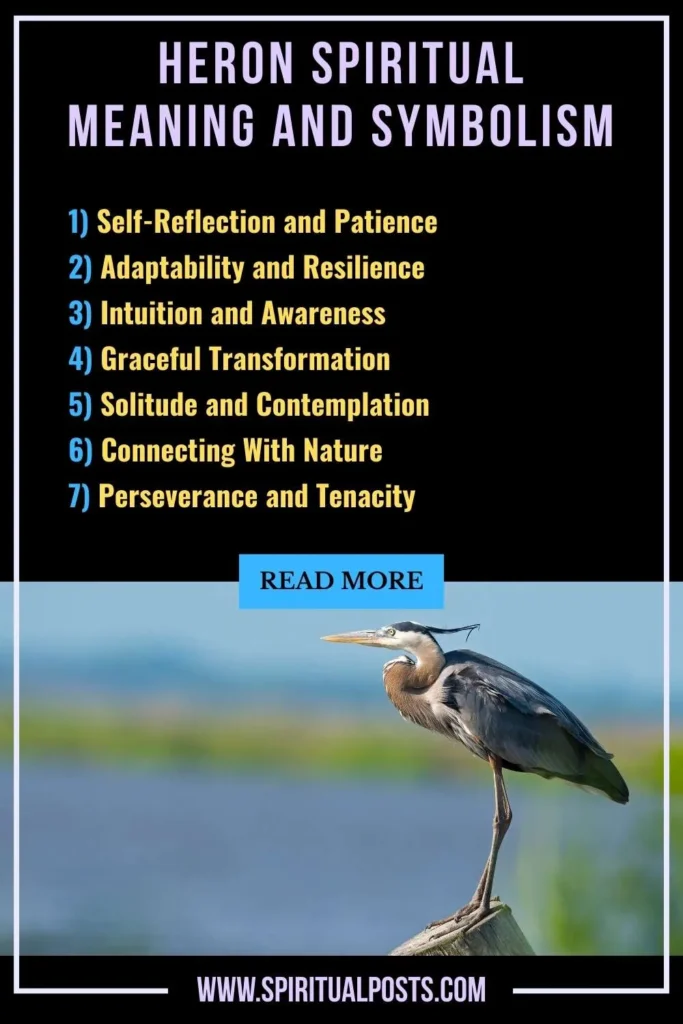
The heron is more than a bird—it holds deep spiritual meaning that speaks to parts of us that often go unnoticed. It teaches patience, self-reflection, awareness, and the beauty of change. Watching a heron in its natural space can remind you to stay calm and centered, even when everything else feels out of control.
This elegant bird doesn’t rush. It moves slowly and intentionally, showing us how to live with more thought and less noise. Herons can thrive in all kinds of environments, which also shows us how to be more flexible and open in our own lives.
When you’re around herons—or even dreaming about them—it’s often a sign to pay attention. Your inner self may be trying to guide you. By noticing the heron’s behavior, you can find clues for how to handle certain situations in your own life.
Below are seven spiritual meanings of the heron, explained clearly so they’re easy to connect with. Each one can help you understand your spiritual path a little better, especially during times of change or reflection.
1. Self-Reflection and Patience
When you look at a heron standing still, you’re seeing more than just a bird resting. That stillness is a powerful example of patience and inner awareness. Herons don’t rush their next move—they wait, fully present, until the time is right.
You can take this as a message to slow down and check in with yourself. Life isn’t always about doing more; sometimes, it’s about doing less and really thinking about what matters most. This helps you grow on the inside.
One important thing the heron teaches is how to be in the moment. Its focus reminds you to stop worrying about yesterday or tomorrow. Being fully here—right now—is what helps you make better choices.
Also, the heron’s ability to stay calm and alert points to the strength of listening to your own intuition. You don’t need to have all the answers—you just need to trust what you already feel inside.
2. Adaptability and Resilience
Herons can live in many types of places—lakes, rivers, oceans, and even swamps. This shows how they adjust easily, which reflects your own power to adapt and stay strong in difficult situations.
When life throws something unexpected your way, the heron reminds you that you can handle it. With long, steady legs, it stands tall even when water rushes beneath it. That balance is something you can find inside yourself, too.
Even when things feel uncertain or uncomfortable, you still have the ability to remain grounded. You may bend, but you won’t break, as long as you trust your inner strength.
The heron also reminds you to move slowly and with purpose. You don’t have to react right away. You can pause, think clearly, and then act in a way that matches your true values.
3. Intuition and Awareness
The heron has very sharp senses. It knows when to move and when to stay still. That level of awareness is a reminder to trust your gut and pay attention to what’s going on around you.
If something feels off, it probably is. The heron shows you how to stay alert and connected to your inner knowing, even when things are quiet on the outside.
By watching the heron, you’re reminded that you already have the tools to sense when something’s right or wrong. It’s about learning to listen to those quiet thoughts inside you.
Also, herons don’t let distractions pull them away from their goals. They focus until it’s time to act. That kind of focus helps you build stronger awareness in both your spiritual and everyday life.
4. Graceful Transformation
Transformation doesn’t always happen overnight. The heron’s slow, smooth movements show that real change takes time and attention. Nothing about it is rushed—and that’s a powerful lesson.
Sometimes, parts of your life will fall away to make room for something better. The heron reminds you that this is natural. You’re allowed to change, grow, and become a new version of yourself.
The heron’s wings stretch out fully when it takes flight. That moment shows freedom. It’s a signal that when you let go of what no longer helps you, you can rise and reach greater heights.
Also, the way the heron glides through air and water points to the idea that transformation can be both peaceful and strong. You’re not forcing change—you’re flowing into it.
5. Solitude and Contemplation
You’ll often see a heron alone, standing quietly by the water. This isn’t loneliness—it’s a kind of peace that comes from being with your own thoughts. Sometimes, silence is where you hear the most.
Taking time for yourself helps you sort through emotions, memories, and decisions. It’s not always easy, but it brings clarity and healing.
The heron reminds you that stepping back from the noise is okay. In fact, it’s necessary. You don’t always need to explain yourself or be part of the crowd.
By following the heron’s example, you can create a calm space in your mind. That space gives you room to reflect, ask deeper questions, and listen to what your spirit really needs.
6. Connecting With Nature
When you’re near a heron, something changes in how you feel about the world around you. The calm way it stands and moves can make you want to slow down too, paying more attention to what’s happening in nature.
The heron doesn’t rush. It stays still and watches, and that can remind you how important it is to take quiet moments for yourself. These peaceful times help you think more clearly and feel more connected to life.
As you keep watching the heron, you might start to feel like you’re part of something bigger. Nature stops feeling separate, and instead, it feels like a living system that you belong to.
The heron can walk on land and move through water with ease. This shows how everything in nature is linked, even if it seems different on the surface.
Spending time with the heron can change how you see the world. You start to care more about all living things, not because someone told you to, but because you feel that connection deep inside.
7. Perseverance and Tenacity
The heron’s quiet strength reminds you that staying strong during hard times is possible. It doesn’t give up when things get tough, and that’s a powerful message for anyone facing challenges.
When hunting, the heron can stand completely still for a long time. It waits patiently until the exact right moment. This kind of patience shows that success doesn’t always come fast, but it can come if you’re steady and focused.
Herons live in many different places—from peaceful wetlands to busy city parks. No matter where they are, they adjust and keep going. That shows how being flexible can help you do well, even when things don’t go as planned.
Even with threats from nature and people, the heron keeps surviving. It bounces back again and again, showing how strong and graceful it really is.
When the heron focuses on a goal, like catching food or flying long distances, it doesn’t let anything stop it. That kind of determination can remind you to stick with your goals, no matter how far away they seem.
Heron Symbolism in Different Cultures and Contexts
The heron holds deep spiritual meaning across many cultures. These tall, graceful birds are seen as messengers, symbols of patience, and guides between worlds. From Native American traditions to Eastern philosophies, the heron’s significance stretches far and wide.
Different societies admire the heron for its calm presence and sharp awareness. Whether standing still in water or soaring through the sky, it represents balance, wisdom, and adaptability. This universal respect shows how deeply humans connect with nature’s symbols.
Native American Culture
In Native American traditions, the heron is a bridge between the physical and spiritual worlds. Its slow, careful movements teach the value of patience and focus. Many tribes see it as a sign to stay observant and trust in timing.
The heron’s hunting style reflects determination and precision. By waiting silently, it reminds people to watch, learn, and act wisely. Its ability to move between land, water, and air symbolizes adaptability and growth.
Water plays a key role in the heron’s symbolism, linking it to purity and divine connection. Some believe herons carry messages from ancestors or spirits. This makes them sacred guides in many tribal stories.
Celtic Culture
Celtic traditions view the heron as a wise and mystical bird. Its long legs, standing between shallow and deep water, represent the balance of opposites. To the Celts, herons show how the physical and spiritual worlds overlap.
The bird’s slow, deliberate movements teach the importance of mindfulness. Celtic mystics admired its ability to stay calm in changing conditions. It became a symbol of inner strength and focus in their teachings.
Herons also represent patience and perfect timing. Just as they wait to catch prey, the Celts saw them as reminders to trust the right moment. Their presence in myths often signaled a time for reflection or transformation.
Nordic Culture
In Norse mythology, the heron is tied to Odin, the god of wisdom. Like Odin, herons move between realms, acting as messengers and observers. Their sharp eyesight mirrors Odin’s all-knowing nature.
Some legends describe herons as shapeshifters, much like Odin himself. This links them to magic and hidden knowledge. Their long necks symbolize the connection between thought (head) and feeling (heart).
Water edges, where herons often stand, were seen as gateways to other worlds. Vikings and Nordic peoples respected the heron’s ability to navigate both seen and unseen realms.
African Culture
Across Africa, the heron is a symbol of wisdom and spiritual insight. Its quiet, watchful nature teaches the value of stillness and awareness. Many cultures see it as a mediator between humans and the divine.
The heron’s patience while hunting reflects discipline and focus. African traditions often use it to represent vigilance and perception. Its connection to water ties it to cleansing, life, and renewal.
In some regions, herons are considered sacred messengers. Their graceful movements inspire stories about harmony and balance. They remind people to stay calm and observant in all situations.
Eastern Culture
In Eastern traditions, herons (and cranes) symbolize grace, longevity, and good fortune. Zen Buddhism admires their meditative stillness, seeing them as models of focus and peace.
Japanese folklore treats herons as divine messengers, bringing blessings. Chinese art often paints them to represent elegance and harmony with nature. Their presence in myths highlights tranquility and spiritual growth.
Hindu and Buddhist teachings link herons to water’s cyclical nature—life, death, and rebirth. Their beauty and poise make them powerful symbols in art and spirituality. Even today, they inspire mindfulness and reverence in Eastern cultures.
Hindu Culture
In Hindu culture, the heron symbolizes the cycle of life, death, and rebirth. It’s often linked to Shiva, the god who oversees creation, preservation, and destruction. The heron’s calm, meditative posture reflects the fluidity of existence and how everything in life is connected.
The bird’s long neck represents the spiritual journey, with the head symbolizing higher awareness and the body representing the physical world. This idea is reinforced in Hindu art and literature, where herons stand for wisdom, patience, and enlightenment. Their presence in sacred texts and paintings highlights their deep spiritual meaning.
Arts and Literature
The heron’s symbolism isn’t limited to Hinduism—it appears in art and literature worldwide, each culture giving it unique meaning. In classical East Asian paintings, herons symbolize elegance, solitude, and deep thought. Their graceful form captures a sense of quiet reflection.
In European art, like tapestries and frescoes, herons represent patience and watchfulness. Poets from Japanese haiku to modern free verse celebrate the heron’s thoughtful nature and bond with the natural world. These works show how the heron inspires creativity across different traditions.
Mythology
The heron holds sacred meaning in mythologies around the world. In ancient Egypt, it was tied to Thoth, the god of wisdom and writing, symbolizing careful thought and knowledge. The bird’s calm presence mirrored the god’s wise nature.
In Greek mythology, herons were linked to Athena, representing foresight and strategy. Native American traditions see the heron as a messenger between worlds, guiding people in their spiritual growth. Its ability to move between land and water shows balance between different realms.
Heron Biblical Meanings
The Bible mentions herons as unclean birds in Leviticus 11:19 and Deuteronomy 14:18, but they still carry spiritual lessons. Their symbolism includes impurity, reminding people to avoid negative influences. At the same time, their sharp vision and patience teach discernment and careful judgment.
The heron’s calm, deliberate movements encourage patience in spiritual growth. Its ability to thrive in different environments also represents adaptability and strength when facing challenges. These traits make the heron a meaningful symbol in biblical teachings.
Spiritual Meaning of Dreaming About a Heron
Dreaming of a heron often signals patience, focus, and inner reflection. The bird’s stillness in water suggests you may need to pause and listen to your intuition. Its connection to water also points to emotions and subconscious thoughts that need attention.
The way the heron acts in your dream can offer clues—waiting calmly might mean you should be more patient, while taking flight could symbolize new beginnings. These dreams encourage mindfulness and trusting your spiritual path.
Heron Spirit Animal
If the heron is your spirit animal, it teaches stillness, observation, and purposeful action. It shows the value of waiting for the right moment instead of rushing. The heron’s sharp focus reminds you to notice small details that others miss.
As a totem or power animal, the heron guides you to move with grace and conserve energy. It encourages steady problem-solving and trusting your instincts. Those who connect with the heron often find deeper peace and clarity in life.
Final Thoughts
The heron’s symbolism spans cultures, religions, and art, serving as a bridge between the physical and spiritual worlds. Its calm presence teaches patience, awareness, and resilience, inspiring people to live more thoughtfully.
By exploring the heron’s many meanings, we gain a richer understanding of life’s balance and our own spiritual journey. This majestic bird reminds us to move through challenges with grace and wisdom.
You Might Also Like
1) Hawk Spiritual Meanings and Symbolism
2) Blue Cardinal Spiritual Meanings and Symbolism
3) Warbler Spiritual Meanings and Symbolism
4) Emu Spiritual Meanings and Symbolism
5) Beetle Spiritual Meanings and Symbolism
FAQs
1. What does a heron symbolize?
A heron symbolizes patience, stillness, and self-reliance. It represents the ability to wait for the right moment to act rather than rushing in. Seeing a heron is a reminder to slow down, be still, and trust your own timing.
2. What can we learn from the heron's hunting style?
The heron stands completely still for a long time before striking. This teaches the power of patience. You do not always need to be doing something. Sometimes, the most powerful action is stillness. The heron reminds you to wait for the right opportunity rather than forcing things.
3. How does the heron relate to balance?
Herons live between land and water. They are comfortable in both worlds. This represents the balance between your outer life (land) and your inner emotional life (water). The heron encourages you to honor both. Do not ignore your feelings in favor of action, and do not get lost in your emotions without taking action in the world.